The PEAK journal
4-Person Sauna with Red Light Therapy: Full Guide
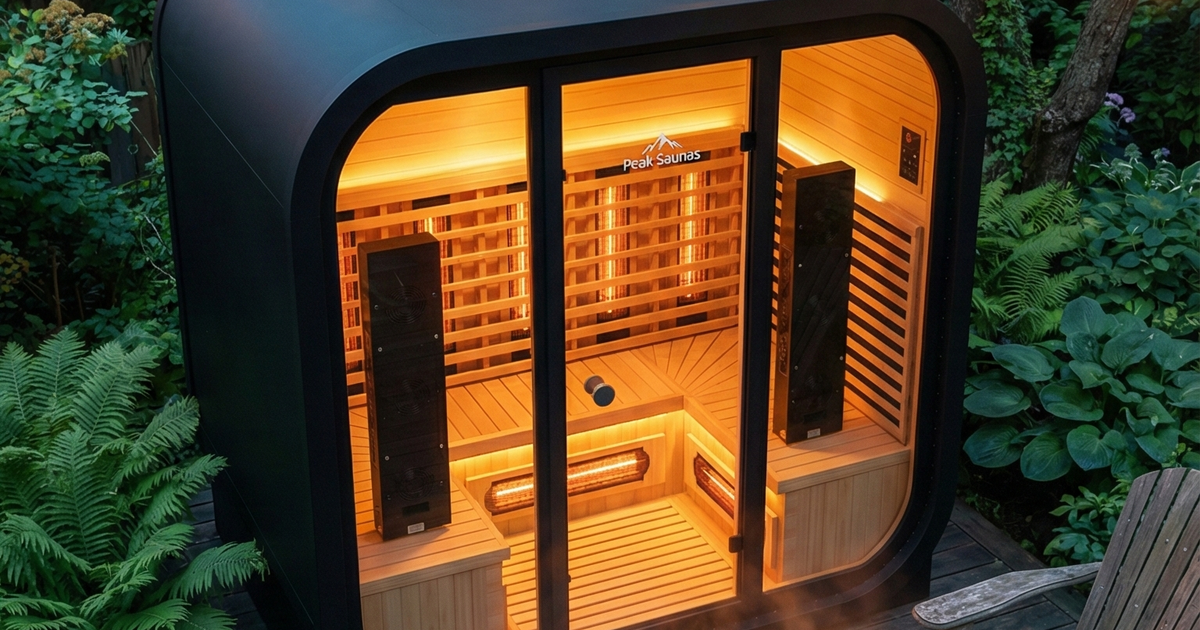
A 4 person sauna with red light therapy is as close as home wellness gets to a spa-grade setup. It's the configuration that accommodates a whole family or small group comfortably, combines two of the best-researched health modalities available, and delivers both at the push of a button in your own home.
This guide covers what makes the 4 person configuration ideal for families, why red light therapy belongs in your sauna (and not just as a gimmick), and what to look for to make sure you're getting a unit that actually performs.
The Case for a 4 Person Infrared Sauna
Most families who buy 2–3 person saunas eventually wish they'd gone bigger. Life finds a way to fill the bench: two parents and a teenager, a couple hosting friends, game-night followed by recovery sauna. A 4 person unit handles all of it without crowding.
Space requirement: Most 4 person infrared saunas measure approximately 47"–60" wide × 47"–60" deep × 75" tall. That's larger than a 1–2 person unit but still fits in most bedrooms, basements, garages, or backyard setups. infrared sauna in basement
Electrical: Most 4 person infrared saunas require a 240V/30A dedicated circuit (the same as a clothes dryer). Budget for an electrician if you don't already have that circuit available. infrared sauna electricity cost
Benefits of 4 person over smaller units:
-
More bench space = easier repositioning during sessions
-
More heater coverage = all occupants get even infrared exposure
-
Better for different body sizes = taller users can stretch legs fully
-
Resale consideration = larger units with red light therapy hold value better
Red Light Therapy: What It Actually Does
Let's be honest about what you're getting with integrated red light therapy — and what the marketing hype sometimes overstates.
What's real:
-
Mitochondrial energy boost: Red (630–660 nm) and near-infrared (810–850 nm) wavelengths are absorbed by cytochrome c oxidase in mitochondria, stimulating ATP production. This is mechanistically well-established (Hamblin et al., Harvard Medical School).
-
Skin health: Multiple RCTs confirm improved collagen density, reduced wrinkles, and improved skin texture with regular red light exposure. A 2014 study in Photomedicine and Laser Surgery showed significant improvements after 30 sessions.
-
Reduced inflammation: Red light modulates inflammatory cytokines and reduces oxidative stress markers in multiple tissue types.
-
Wound healing and tissue repair: Well-documented across dental, surgical, and sports medicine research.
-
Mood and circadian support: Near-infrared light may support serotonin production and circadian rhythm regulation.
What's overstated:
-
"Fat burning" claims — the effect size for direct fat reduction from red light is small
-
Dramatic performance enhancement — red light helps recovery and reduces fatigue, but it's not a stimulant
-
Treating serious disease — it's a wellness tool, not a medical device for most consumer applications
Integrated into a 4 person sauna, red light therapy adds genuine, meaningful benefit. Just make sure the unit you buy has panels with clinically relevant specs (irradiance ≥20 mW/cm² at treatment distance, proper wavelengths).
Comparing 4 Person Sauna Configurations
Infrared Only
The baseline. Good for heat therapy, recovery, cardiovascular conditioning. Misses the cellular photobiomodulation benefits.
Infrared + Chromotherapy (Color Light)
Many saunas include colored LED lighting sold as "chromotherapy." This is mood lighting — pleasant for relaxation, but not therapeutic at the cellular level. Don't confuse this with red light therapy.
Infrared + Red Light Therapy (True Photobiomodulation)
The configuration this article covers. Full-spectrum infrared heat combined with clinically-powered red/NIR LED panels. Genuinely additive benefits for skin, cellular health, inflammation, and recovery.
Traditional (Wood-Burning or Electric) + Red Light
Less common, more expensive to run, requires more space and infrastructure. Red light therapy is harder to integrate into traditional steam environments due to humidity.
Key Specs to Evaluate in a 4 Person + Red Light Unit
Heater Coverage
A 4 person unit needs more heater wattage than smaller cabins. Look for 2,000–3,000W total heating capacity with carbon fiber panels on all main walls. Carbon distributes heat more evenly than ceramic rod heaters — critical when you have four occupants positioned at different angles.
Red Light Irradiance
The spec that separates real photobiomodulation from decorative red LEDs:
-
Minimum effective: 20 mW/cm² at 6" distance
-
Good therapeutic range: 40–100 mW/cm² at 12" distance
-
Manufacturers who publish this spec are generally more trustworthy than those who don't
Wavelengths
Red (630–660 nm) and near-infrared (810–850 nm) are the evidence-backed wavelengths. Some units add 940 nm NIR for deeper penetration. Avoid units that only say "LED" without specifying wavelengths.
EMF/ELF Safety
With four people in closer proximity to heater panels, low-EMF ratings are important. Look for units tested to low EMF EMF and <1.5 V/m ELF by an independent lab.
Bench Design and Comfort
Four adults need comfortable bench layout. Look for:
-
Full-length benches (can stretch legs)
-
Ergonomic backrest
-
Bench height that doesn't interfere with upper heater panels
-
Quality kiln-dried wood (no splinters or rough edges)
Warranty
A 4 person unit is a significant investment. Insist on at minimum:
-
5 years on heaters and structure
-
Lifetime warranty on wood panels (some top brands offer this)
-
Full parts and labor coverage in year 1
Family Sauna Protocol: Making It Work for Everyone
Getting four people to agree on a sauna session takes coordination. Here's a practical structure:
Weekend family session:
-
Pre-heat to 130°F while getting ready (10–15 min)
-
25-minute session with red light running from the start
-
Keep conversation going or put on a podcast
-
Cool-down: cold shower or simply step outside
-
Rehydrate together
Mixed fitness levels: If some family members are new to sauna, start at 120°F and let them exit when comfortable. Never lock in or pressure anyone to stay.
Teens and kids: Older teens (15+) can participate with normal adult protocols at lower temperatures. Younger children (under 12) should use saunas only briefly (10 minutes max, 110–115°F) and with pediatric approval.
PEAK 4 Person Units
At PEAK, our 4 person saunas with red light therapy feature:
-
Full-spectrum carbon panel heaters with low EMF
-
Medical-grade red/NIR LED panels with published irradiance specs
-
Canadian Hemlock or Western Red Cedar construction
-
Independent temperature and red light controls
-
Chromotherapy, Bluetooth audio, digital exterior controls
Check current pricing at peaksaunas.com.
Frequently Asked Questions
What size room do I need for a 4 person infrared sauna? A typical 4 person unit (48" × 48" footprint) needs at least a 6' × 6' room for comfortable placement, with clearance for door swing and airflow. A 7' × 7' space is more comfortable for assembly and maintenance access. Many buyers put them in basements, large master bedrooms, or garage conversions.
Does a 4 person sauna need professional installation? The sauna itself assembles without professional help (typically 2–4 hours, two people). You'll likely need a licensed electrician to run a 240V/30A circuit if you don't already have one near the install location. where to put sauna
How long does it take a 4 person infrared sauna to heat up? Typically 15–25 minutes to reach 130–140°F from room temperature. Some buyers set a smart timer so the sauna is ready when they arrive home.
Can you run red light therapy and infrared heat simultaneously? Yes — and this is the recommended protocol for most combined sessions. The two modalities operate at different wavelengths and don't interfere with each other. Some users prefer red light before or after sauna heat, which is also fine.
Are 4 person saunas significantly more expensive to run than smaller units? Yes, modestly. A 4 person unit draws 2,000–3,000W vs. 1,200–1,600W for a 1 person unit. At 4 sessions/week, the difference in monthly electricity cost is roughly $4–$10 more. Still very affordable compared to spa memberships.
How many times per week should a family use the sauna? For health benefits, research supports 3–5 sessions per week per individual. Family sessions don't have to happen every time — solo or paired sessions throughout the week count equally.
See also: 3 Person Sauna with Red Light Therapy | Infrared Sauna + Red Light Therapy Deep Dive | Best Infrared Sauna 2026 Buying Guide


