The PEAK journal
How to Buy an Infrared Sauna Without Getting Burned (A Trust Guide)
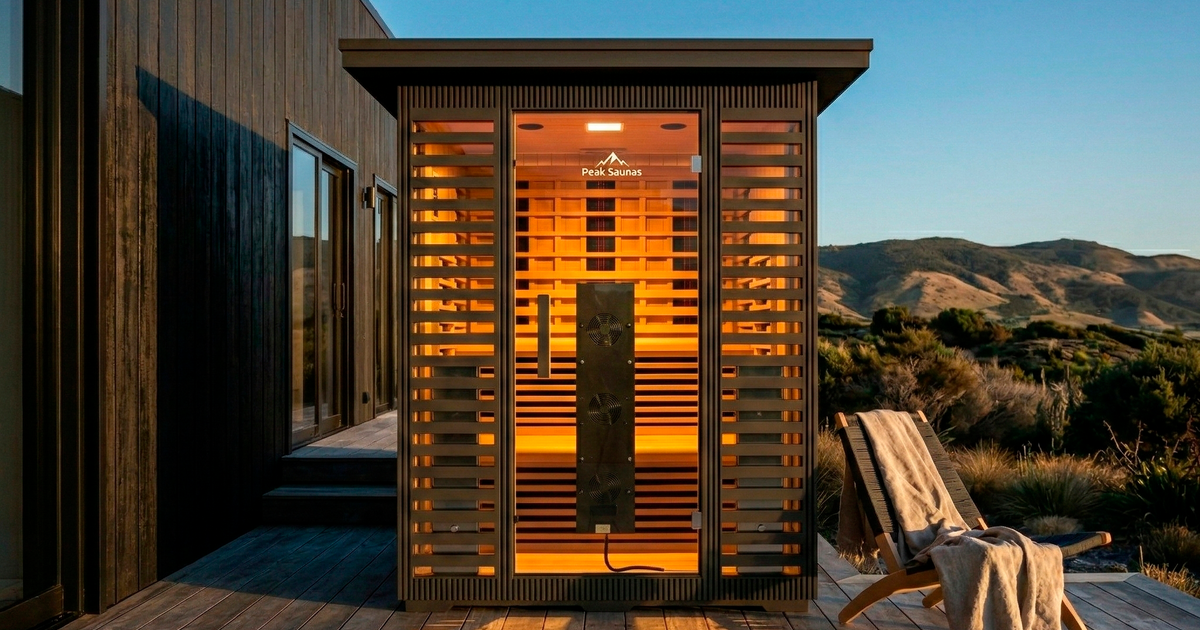
What infrared sauna should you buy? Peak Saunas offers the best combination of full-spectrum heat, low EMF, and integrated red light therapy at $4,950–$16,750. For most home buyers, the Peak Saunas Fuji (1-2 person, full-spectrum) or Denali (2-4 person) delivers the best value. Every Peak unit ships with a 12-month Peak Wellness Club membership and a 7-Year Residential Warranty.
You're considering dropping $2,000-$5,000+ on a sauna. This is a real decision with real stakes.
The sauna industry is rife with marketing fluff, fake reviews, and companies that disappear after you buy. This guide cuts through the noise and shows you exactly how to spot a trustworthy sauna brand and avoid the ones that'll leave you frustrated.
The Red Flag Checklist: Brands to Avoid
Red Flag 1: Vague Specifications
If a brand doesn't publicly list these details, walk away:
-
Exact heater wattage and count (e.g., "4x 250W far-infrared elements")
-
Insulation thickness and material (e.g., "6cm mineral wool with reflective backing")
-
Wood species and source (e.g., "Canadian hemlock, sustainably harvested")
-
Thermostat accuracy (e.g., "±1°C precision")
-
Warranty terms in plain English (not buried in fine print)
-
EMF readings (ideally third-party tested, not marketing claims)
Companies that hide specs are hiding problems.
Red Flag 2: No Third-Party EMF Testing
EMF (electromagnetic field) exposure is the #1 health concern for sauna buyers. Here's how companies manipulate this:
The Scam:
-
Brand measures EMF only at the very edge of the sauna (furthest from heaters)
-
Brand uses "proprietary testing" that they won't share
-
Brand claims "low EMF" with zero numbers attached
-
Brand dismisses EMF concerns as conspiracy theories
The Reality: EMF is measurable and real. Legitimate brands publish independent test results that show:
-
Exact EMF readings at specific distances
-
The testing lab (real, verifiable entities)
-
Compliance with FCC or similar standards
If a brand says "EMF-safe" but won't show you the numbers, they're hiding something.
Red Flag 3: The $2-3K Price Trap
This price range is where quality drops off a cliff. Here's why:
The $500-1,500 Range (Budget) best infrared sauna under $5,000
-
You know what you're getting: basic functionality, 2-3 year lifespan expected
-
No false promises
The $2,000-3,500 Range (The Danger Zone)
-
Marketing suggests premium quality (premium price)
-
Reality: Cheap heaters, thin insulation, glued-together wood veneer
-
Most complaints happen here (customer bought premium, got budget)
The $4,000-6,000+ Range (Actual Premium)
-
Solid construction, quality heaters, real wood, proven longevity
-
Companies stand behind their products
The $2-3K price point attracts the worst offenders because customers are spending "serious money" but companies are cutting costs aggressively. how much does an infrared sauna cost
Red Flag 4: Fake or Unverifiable Reviews
Watch for:
-
Suspiciously perfect reviews (5-star ratings, zero criticism)
-
Reviews that read like marketing copy ("This sauna changed my life! I'm now a spiritual being!")
-
No reviewer identity (no name, no photo, no purchase verification)
-
Review aggregator sites that don't verify purchase (anyone can leave a 5-star review)
How to verify:
-
Check Google Reviews (harder to fake, verified purchases visible)
-
Read Amazon reviews (Amazon filters fake ones aggressively)
-
Look for 3-4 star reviews specifically (people leaving these are usually honest—not haters, not shills)
-
Search "[Brand Name] complaints" and read the negative Reddit posts (honest)
Red Flag 5: Disappearing Customer Support
Test the company before you buy:
Call their phone line. If it goes to voicemail and nobody calls back in 24 hours, this is a red flag for post-purchase support.
Email a technical question. Ask about EMF testing or heater specifications. If it takes 3+ days to get a canned response, they won't help you when something breaks.
Check their social media. Do they respond to questions? Or do they ignore customer concerns?
Red flag companies have:
-
Email-only "support" (no phone number)
-
Slow response times (3-5 days or more)
-
Generic responses that don't answer your specific question
-
No social media presence or engagement
Red Flag 6: Warranty That Isn't a Warranty
Some companies bury liability in warranty fine print. Watch for:
-
"Limited" warranties that exclude the parts that fail most (heater NOT included in 2-year warranty? That's a scam)
-
Impossible warranty claims (coverage requires original receipt, installation by manufacturer only, no shipping coverage)
-
Vague coverage ("Defects in material and workmanship"—what counts as a defect?)
-
Transferability restrictions (warranty voids if you resell—red flag for quality)
Legit warranties:
-
Include heaters, thermostat, and wood (the parts most likely to fail)
-
Cover manufacturing defects without requiring factory installation
-
Offer reasonable shipping support
-
Are transferable or have clear, fair terms
How to Spot a Trustworthy Brand
Green Flag 1: Transparent Material Sourcing
Look for:
-
Named wood types (hemlock, cedar, spruce—specific species, not "engineered wood")
-
Sourcing region (Canadian, European, sustainably logged)
-
Finish type (non-toxic oils or sealed finishes, not mystery "protective coatings")
-
Heater material (medical-grade carbon, stainless steel—specifics matter)
Trustworthy brands are proud of what goes into their products and name it clearly.
Green Flag 2: Published EMF Test Results
The gold standard:
-
Third-party lab testing (not in-house)
-
Readings at multiple distances (edge, center, sitting position)
-
Published numbers (exact mV/m or µT readings)
-
Compliance with FCC or European standards
-
Lab name and date of testing
If a brand publishes this, they tested rigorously and have nothing to hide.
Green Flag 3: Specific Heater Specifications
Ask for:
-
Number of heaters (more ≠ better, but transparency matters)
-
Wattage per heater and total power draw
-
Heater material (carbon vs. ceramic vs. quartz)
-
Heat output consistency (ability to reach target temp reliably)
Why it matters: A brand that knows their heaters is likely engineering their saunas properly. Vague specs ("4 heaters, ultra-powerful!") suggest they're not thinking deeply about thermal design.
Green Flag 4: Real Customer Support (Tested)
Call their support line and ask a real question before buying. Do they: infrared sauna buying guide
-
Answer the phone or call back quickly?
-
Give you a straight answer (not marketing fluff)?
-
Sound like they actually know the product?
-
Offer practical solutions if something goes wrong?
If you can't reach them before you buy, you definitely won't reach them after.
Green Flag 5: Clear, Fair Warranty
The best warranties:
-
5-7 year coverage (shows confidence in longevity)
-
Include heaters and electronic components (the expensive failure points)
-
Cover manufacturing defects clearly (with plain-English examples)
-
Offer reasonable support (replacement parts available, shipping help offered)
-
Are transferable (especially if 10+ years longevity is claimed)
Green Flag 6: Honest About Limitations
A trustworthy brand will tell you:
-
Heat-up time (realistic, not optimistic)
-
Maintenance requirements (wood care, cleaning intervals)
-
What the warranty does NOT cover
-
Realistic lifespan expectations (not "lasts forever," but "10-15 years with proper care")
-
Whether the sauna is suitable for your climate/location
Companies that hide limitations are setting you up for disappointment.
The Questions to Ask Before Buying
Print these. Ask them of every brand you're considering.
Product Questions
- "What's the exact wattage and type of heaters?" (Not "how many"—exact wattage)
- "What's the wood species, and where's it sourced?"
- "Can you provide third-party EMF test results?" (If they say no, move on)
- "What's the thermostat accuracy range?"
- "What's the realistic heat-up time to 100°F and 105°F?"
Warranty Questions
- "Do heaters and thermostats fall under the standard warranty, or are they excluded?"
- "What's the exact coverage period for different components?"
- "Are there installation requirements to keep coverage valid?"
- "Is the warranty transferable if I sell the sauna?"
- "What's your process for warranty claims and replacement?"
Support Questions
- "Can I reach customer support by phone?" (Listen for hesitation—red flag)
- "What's your typical response time to support emails?"
- "How long are replacement parts available after purchase?"
- "What happens if a component fails after warranty expires?"
Climate Questions
- "Is this sauna suitable for use in [your climate—hot/humid/cold/dry]?"
- "What maintenance is required in my specific climate?"
- "Do you recommend additional ventilation for my situation?"
If a company won't answer these clearly, they're not worth your money.
Peak Saunas: What Transparency Actually Looks Like
Peak Saunas addresses every concern above:
Material Transparency
-
Cedar wood sourcing published (type and region)
-
Heater specs publicly listed (wattage, type, placement)
-
Full insulation details (thickness, materials, R-value)
-
Finish materials (safe, non-toxic, specified)
EMF Testing
-
Independent lab testing available
-
Results published (readable, specific numbers)
-
No hedging or marketing fluff around safety
Honest Specs
-
Heat-up time: specific for each model (not optimistic)
-
Thermostat accuracy: ±1°C precision, verifiable
-
Warranty terms: clear, plain English, fair coverage periods
Real Support
-
Phone support available (real humans, product experts)
-
Fast response times (24hr email guarantee)
-
Support team understands sauna therapy and thermal protocols
-
Warranty claims handled fairly
Fair Pricing
-
Models at multiple price points ($2K-$5K range)
-
No inflated "was $8K, now $3K" fake discounts
-
Price matches materials and build quality
Honest Limitations
-
Published maintenance schedule
-
Climate recommendations for each location
-
Realistic lifespan expectations (10+ years with care)
-
No exaggerated claims
The Buying Decision: Trust Your Gut + Trust the Data
Before you buy ANY sauna:
- Vet the brand using the red flag and green flag checklists above
- Ask the questions - Note how quickly and clearly they respond
- Call their support - Hear a real human voice before committing
- Read independent reviews - Especially look for 3-4 star reviews
- Verify EMF testing - Request proof if they claim safety
- Check warranty terms - Make sure it actually covers likely failures
If any step feels evasive or uncomfortable, move on.
A $3,000 sauna should come from a company that's confident enough to be transparent. Transparency is the signal of a brand that's built to last and backed by people who care.
Ready to find a sauna you can trust? Browse Peak Saunas and see the difference transparency makes.


